Using Music to Cope with Transitions to the World of Work
Special Education-12th Grade

Introduction
Imagine you are at work. Your supervisor comes up to and says on a Friday, "Can you take on this project and have it completed by Monday?"
You look at your schedule. You are swamped...you have taken on too much already both at home and at work. You are living by yourself, paying your own bills, and have family issues at the moment.
You can feel your heart pounding, your breathing becoming shallow, you tense your hands, your neck is stiff. You cannot make a decision when feeling as as stressed as you are.
How can you use music to help you reduce stress, make a decision, and to tell your supervisor your decision while still advocating for your needs? Let's find out.

Task
You are stressed to the max. You don't know what to tell your boss. You can't make a decision because you are so overwhelmed.
As an adult, it is essential to learn how to make decisions and to tell your advisor about your decision while still advocating for your needs as their employee.
In this quest, you and three other classmates are going to learn how to use music to help you manage your stress, make a decision, talk to your boss, and advocate for your needs. During this quest, you will choose songs that fit each of these scenarios. At the end of this quest, you and your classmates will turn in a playlist of songs that can be very helpful in managing stressful situations that you will encounter in the future.

Thawing the frozen middle

Group of diverse people having a business meeting
Process
1. First you'll be assigned to a team of three students. Each team member has a choice of three roles, one per student, which are:
-
Group Leader=This is the person in charge of the group and represents the group when discussing group questions or concerns to the teacher.
-
Group Technology Expert=This is the person who helps the group with any technological issues and uses their technological expertise to help with online research and create the final group playlist.
-
Group Music Expert=This is the person with the most extensive, most diverse music knowledge of the group. They are in charge of helping create and find songs for the group's playlist.
If you don't feel comfortable with working in groups for this project or would prefer to work by yourself, just let the teacher know your decision before you start on the project. This project can be completed individually.
2. Once your group has the group job for each person, you will begin researching using the four website links the teacher has provided to answer the guiding question for your quest: "How can you use music to help you reduce stress, make a decision, and to tell your supervisor your decision while still advocating for your needs?" At the end of this quest, you and your group should have completed and submitted a group music playlist to the teacher via this website.
3. Read the description and tasks for each of the websites below before you click on the link.
Task:When you click on the "first website" button, it takes you directly to the Google search engine, which will help you find the websites. At the end of this task, your group should have three articles you can use to help inform your knowledge and the rest of the project.
Focus for Task: When using Google, focus on "music therapy and how it relates to communication."
-
Note: All websites on this quest have been vetted by the teacher, so you should be able to find scholarly articles related to the subtopic, which in this case, is "music therapy and communication."
Reminders: 1) You are awesome and amazing, and you are going to do well on this project!!! ,2) All articles for this project should be scholarly, credible, and recent (within the last five years), and 3) While you are working in groups, the teacher will be available for help and to answer questions.


Click Me!!!


Task: When you click on the second website button, it takes you directly to the Journal of Visual Experiments (JoVE) website. At the end of this task your group should have two articles.
Focus for Task: When using JoVE, focus on "music and stress reduction." Read the articles and watch the videos as needed.
-
Note: Your group will need to create an account to get full access to all of the sections of the articles. 1) When creating an account, use your school email, 2) when it asks for the institution, choose "other," and 3) when it asks for your role, choose "other" and say, "student", and 4) you can choose to extend your free trial to thirty minutes to help you get the information you need.
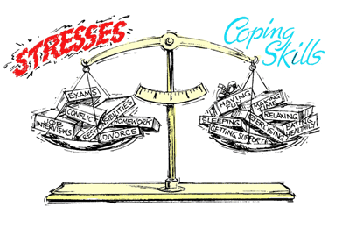

stresses and coping skills
Mind Emotion Loop
Task: When you click on the "third website" button, it takes you directly to your second research website, which is the OhioLink website. At the end of this task, your group should have one article you can use to help inform your knowledge and the rest of the project.
Focus for Task: When using the OhioLink website, focus on "music therapy and transition issues in high school."
-
Note: It will take some time to find an article on this website that pertains to the subtopic of music therapy and transition issues, but it is on there. What is most important is what you learned from the article. Watch the video on this website and read the script, as needed.
Reminders: 1) Organization is key to determining what you do and don't know and can help your group brainstorm ideas, 2) There are multiple ways you can organize information, and 3) when you click on the three buttons on the bottom, they will take you to various ideas you can use to help organize your ideas for this quest.
Click Me!!!

Mind Map Idea
Note-Taking Idea
Outline and Task Idea
Task: When you click on the "fourth website", it takes you directly to Google. At the end of this task, your group should have three articles.
Focus for Task: When using the Google search engine, focus on searching for "how to make tough decisions for yourself and advocate for your needs." Hint: The skills and strategies you find in this search will help you answer the specific problem/question posed in the introduction. Reminder: You can do this!!! You have made it this far, all you have to do is stay focused and keep going.


Girl Disco Headphone

Decisions Way Choice
Task: When you click on the "fifth website" button, it takes you directly to your fifth research website, which is the Smithsonian website. At the end of this task, your group should have one article you can use to help inform your knowledge and the rest of the project.
Focus for Task: When using the Smithsonian website, focus on "how to create a music therapy playlist."
-
Note: At the end of completing all of the tasks for this quest, you should have ten articles to help inform the music choices you make for your group playlist.
-
You will turn in your ten articles and which songs they are associated with on your playlist in a Google document. You can find where to turn in your Google document in the submission form below, as well as the directions for turning in your Google document.
How to Create Your Group Music Playlist:
1. Please click on the image below to get a how-to on how to make a music playlist using Spotify.
2. Use your school email address and use a secure password for your Spotify account.
3. Ask the teacher, your group music expert, or your group technology expert if you have any questions about creating the Spotify playlist.
-
Note: The teacher is more than happy to adjust instruction at any time and to help in response to your individual needs, as well as monitor your progress or struggles.
4. If you click on Spotify Player, it will show you an example of what the teacher is looking for in your final group playlist submission.
5. Below is where your group will submit your final group playlist. You will paste your URL to your playlist in the URL box, type the date, and click the arrows until you have found the correct time. The date and time when submitted are put on the submission form so the teacher knows whether or not your group submitted your playlist on time.
You are encouraged to submit it early and not wait until the last minute.

Click Me!!!
Evaluation
For this project, you will have both individual grades and a group grade. The individual grades will be determined by the individual contributions to research of the articles, the Google document, and the group music playlist. The group grade will be determined by the group music playlist.
I will grade this project by using a rubric which outlines the criteria for your group Google document and music playlist. You and your group can access the complete rubric by clicking on the image below. Don't hesitate to ask the teacher if you need any help understanding the rubric.
Click Me!!!


Conclusion
Congratulations!!! You have completed your quest!!!
In this quest, you have learned about how to solve common problems in the world of work, which are managing stress, making tough decisions, and advocating for your needs by making a group music playlist. This approach is based on scientific research in the field of music therapy. The research skills and problem-solving strategies used in this quest will help you throughout your life.
The songs on the music playlist you created can be used to help you when you encounter stressful situations in the future.

Teacher Section
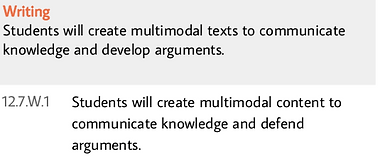
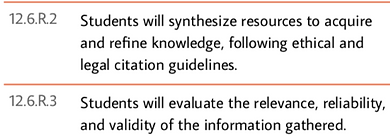
OAS Standards:
ISTE Standards:
Adjustments/Adaptations:
HOTS Critical Thinking:
In my virtual quest, my students will use these levels of Bloom's Cognitive Taxonomy: Remembering, Understanding, Analyzing, and Creating.
Remembering means recalling or retrieving information. This is important because having certain facts memorized makes learning other information easier. For example, you cannot compose complex music without having all of your key signatures and scales memorized. It is also important because if you do not have facts memorized, you should know how to look up facts and where to find factual information.
Understanding means the interpretation and making sense of a problem. Collaborative learning also falls underneath this term. This is important because understanding a problem and knowing how to make your own individual interpretation of a problem helps you create your own solutions to your own interpretation of the problem.
Analyzing means distinguishing between fact and fiction and finding out what is important. This is important because distinguishing between fact and fiction helps you determine which sources are credible and reliable or not. Finding out what is important is essential because when trying to solve a problem, you need to understand the essential problem or the underlying issue, regardless of what your interpretation of the issue is.
Creating means creating something original from the information given. This is important because it shows higher-levels of thinking about the concepts learned and deeper levels of understanding.
In my virtual quest, I have set up the entire quest to help facilitate higher-order thinking skills on Bloom's Cognitive Taxonomy. Students have to use higher-order thinking skills to conduct effective research to find the correct articles over the topics covered, to interpret the articles to give them what they need for each task, to collaborate with their peers in making the final product, to connect the articles they found to the songs they chose and to communicate in writing why they chose their songs, and to create a group music playlist using music they chose.
Students demonstrate remembering by researching for scholarly articles over specific topics using the focus for the task as a limiter. They also demonstrate remembering by citing their sources in their group Google document in the format specified.
They demonstrate understanding by interpreting the articles they read and collaborating with their group members to organize their research, solve technical problems, and to determine what to put on their group Google document and final group music playlist.
Analyzing is demonstrated in my virtual quest by having my students determine which articles are scholarly, whether the information is credible, recent, and scholarly, and what the main idea is for each for each of the articles.
Creating is demonstrated by having students create a Google document that shows the articles they chose, which songs they chose that go with the articles, and why they chose the songs they chose. It is demonstrated even more by having them create a group music playlist.
RUBRIC:
My rubric assesses whether or not students met OAS standards by paraphrasing the OAS standards I used in the "Knowledge and Defense of Arguments in Google document" section and in the "Use of Task Websites (Resources)" one and two.
My rubric assesses whether or not students met HOTs by using these sections in the rubric: "Workload" (collaboration), "Content" (extensive subject knowledge demonstrated), "Knowledge and Defense of Arguments in Google document" (create Google document with research articles with songs and justification for why they used the songs they used), and "Answer Quest/Project Question" (answer an open-ended question, which is not Googleable).
Resources and Materials:
Teacher materials:
-
Computer or laptop
-
Internet access
-
Microsoft Word to access rubric
-
Google to demonstrate examples of group Google documents and receive group Google documents
-
Access to Spotify to show examples of completed group music playlists and to listen as part of final group music playlist grade
-
Headphones to listen to group music playlists
-
Access and storage of articles
Student materials:
-
Computer or laptop (one to three per group)
-
Internet access
-
Google Chrome for Speechnotes (speech-to-text notepad) (if group decides on this organization idea)
-
At least one Android phone to access Outliner application (if group decides on this organization idea)
-
Microsoft Word to access rubric
-
School email address to create JoVE and Spotify accounts (each student needs their own individual school email address)
-
Google for some research tasks and to create group Google document
-
Headphones or earbuds to work on group music playlists
-
Note: If students need assistance and do not have access to their teacher or their group technology expert or group music expert, paraprofessionals and parents or caregivers can help. However, this project is meant to be done primarily by the group members.
Credits & References List:
Alzahrani, S., & Pandey, S. (2017). Transition to Adulthood for Youth with Disability: Issues for the Disabled Child and Family. The International Journal of Engineering and Science, 6(3), 19-24. doi: 10.9790/1813-0603010924. Retrieved from Http://www.theijes.com/papers/vol6-issue3/A0603010108.pdf.
Classroom Accommodations Classroom Accommodations for ESL and ELD Students [PowerPoint slides]. (2009). Newfoundland/Labrador: Newfound Labrador Education. Retrieved from https://www.ed.gov.nl.ca/edu/k12/curriculum/guides/esl/classroom_accommodations.pdf.
Drake, Jennifer. (2014). Music Therapy and Communication Disabilities: Singing, Speech, and the Brain. In BSU Honors Program
Theses and Projects. Item 74. Available at: http://vc.bridgew.edu/honors_proj/74.
Decisions Way Choice. (2019). Retrieved from https://pixabay.com/illustrations/decisions-way-choice-junction-2314120/.
Group of diverse people having a business meeting. (2018). Retrieved from https://pxhere.com/sv/photo/1447827.
Hassan, M. (2019). Girl Disco Headphone. Retrieved from https://pixabay.com/illustrations/girl-disco-headphone-female-music-3679689/.
Hendry, E. R. (2012). Music Playlists to Soothe Your Mind. Retrieved from https://www.smithsonianmag.com/science-nature/music-playlists-to-soothe-your-mind-5466147/.
How to Read a Scholarly Article. (n.d.). Retrieved from https://www.lib.uwo.ca/tutorials/howtoreadascholarlyarticle/.
Linnemann, A., Strahler, J., Nater, U.M. Assessing the Effects of Music Listening on Psychobiological Stress in Daily Life. J. Vis. Exp.
(120), e54920, doi:10.3791/54920 (2017). Retrieved from https://www.jove.com/video/54920.
Mind Emotion Loop. (2015). Retrieved from https://static.wixstatic.com/media/abb595_56384c7f12f745fe922fe7dc87630bd5~mv2_d_2400_1980_s_2.png.
Moreau, E. (2019). Here's How You Can Make an Awesome Spotify Playlist. Retrieved from https://www.lifewire.com/make-a-playlist-on-spotify-4138575.
Morris, S. (2014). Quality of Life Issues for Three Young Adults with Developmental Disabilities Receiving Music Therapy During Transition from High School to Adult Life: A Phenomenological Inquiry . (Electronic Thesis or Dissertation). Retrieved from https://etd.ohiolink.edu/.
Potter, D. (2013). stress and coping skills. Retrieved from https://commons.wikimedia.org/wiki/File:Stress.gif.
Research Guides: Basic Research Strategies for the Social Sciences: Scholarly vs. Non-scholarly Articles. (2019, April 3). Retrieved from https://researchguides.library.syr.edu/socresearch/schlsourc.
Stevens, H. (2018). Thawing the frozen middle: Creech sparks innovation fire. Retrieved from https://www.creech.af.mil/News/Photos/igphoto/2002063150/.
-
Note: All images not cited here are from Wix Images.




For students who have IEPs (specific learning disability (SLD)), I will allow them to work individually, use speech-to-text if they have writing difficulties, use assistive technology (AT), use spell check or electronic dictionary, and I would modify the assignment in accordance to their IEP.
For students who have 504 plans (attention deficit hyperactivity disorder (ADHD)), I will have them use text-to-speech, AT, reverse color contrast, and I would modify the assignment in accordance to their 504 plan.
For students who have English as a second language (ESL/ELL), I will give them direct instructions on how to complete the assignment, allow more time to complete the assignment, and modify the assignment so that they have fewer, simpler questions to answer.